

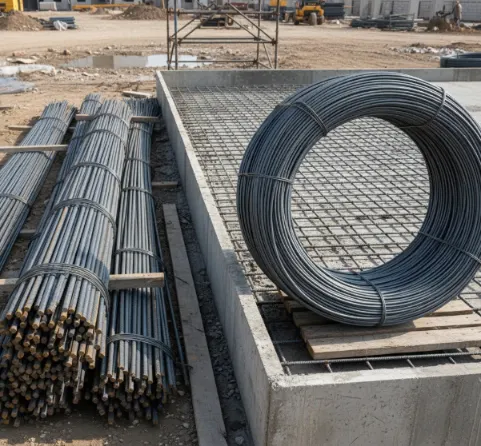
When you specify reinforcement for concrete, you are really buying control. Control over cracks. Control over deflection. Control over what happens after months of vibration, traffic, temperature swings, and small site mistakes that always show up at the worst time. In that decision, “wire rod” and “traditional rebar” get compared a lot, sometimes too casually. They are related products, but they behave differently once concrete cures and the structure starts working.
What Wire Rod Really Is
Wire rod is a hot-rolled steel product shipped in coils. That coil form changes how you store it, handle it, and process it on site. It also hints at the most common use: wire rod often becomes something else before it becomes reinforcement in concrete.
Because buyers use “wire rod” to mean different things, it helps to separate wire rod as a product form from the reinforcement product you finally install.
Form, Size Range, And Typical Use
Wire rod is commonly supplied in smaller diameters and coiled form, while rebar is usually supplied as straight lengths. That difference matters right away. A coil can be shipped and stored efficiently, but it may need straightening and cutting before it fits a reinforcement plan.
In concrete work, wire rod more often feeds downstream products like welded wire mesh, ties, and certain light reinforcement solutions. If you have ever tried to pull a single length cleanly from a tight coil, you already know why many sites prefer finished forms.
Where Wire Rod Shows Up in Concrete Work
Wire rod becomes relevant in concrete structures when you need repeatable spacing, fast placement, or secondary reinforcement. Think slabs, panels, and areas where mesh or ties speed up work. It is not usually a one-for-one swap for load-bearing rebar in beams and columns, but it can be part of the reinforcement system when the design calls for it.
What Traditional Rebar Brings to Concrete
Traditional rebar exists for one job: hold tension where concrete cannot. Concrete handles compression well. Reinforcement handles tension and helps control cracking. Rebar is built around that role, from its surface profile to its common diameters.
So when you compare performance in concrete structures, you are not only comparing strength numbers. You are comparing how the steel “locks” into cured concrete and how reliably it behaves under load cycles.
Ribbed Surface And Bond Strength
Unlike typical wire rod, rebar has a ribbed or textured surface designed to bond with concrete and resist slip. This bond is not a small detail. It is the reason rebar performs so well as primary reinforcement. When bond is strong, load transfers into the steel as intended. When bond is weak, cracks widen and stiffness drops sooner than you want.
Typical Structural Roles
Rebar is widely used in foundations, beams, columns, walls, and heavy slabs. Those are elements where your risk profile is higher. If you are working on structural concrete, “traditional rebar” is usually the default for good reasons.
Wire Rod vs Traditional Rebar: What Changes Performance in Concrete
If you are choosing between wire rod-based reinforcement solutions and traditional rebar, start with the project questions you actually face: What loads matter most? What crack control is required? What installation mistakes are most likely on this site? A simple “which is stronger” approach misses the real drivers.
The comparison becomes clearer when you look at three practical factors: bond, placement, and the fabrication path from mill product to reinforcement on the slab.
Bond And Slip Risk
Rebar’s ribs create mechanical interlock with concrete, which improves bond and reduces slip. If you need primary reinforcement performance, bond is hard to beat. Smooth or lightly profiled reinforcement can still work in some designs, but it usually relies more on detailing, lap length, or special products to manage slip.
So if your biggest concern is “Will this behave the same way after the pour?” rebar often feels safer.
Placement Speed And Repeatability
Wire rod that becomes welded wire mesh can be fast. Less tying. More consistent spacing. Better coverage in the hands of a crew that has done it before. That can help in slabs and flatwork where schedule pressure is real and labor varies week to week.
On the flip side, mesh placement errors happen too. Mesh can end up too low in the slab if chairs are missed. That is not a steel problem. It is a site control problem.
Fabrication And Jobsite Flexibility
Rebar gives you flexibility at the last minute. Need an extra bar? Need to adjust a hook? You can cut and bend on site with standard tools. Wire rod-based solutions often rely on prefabrication, which trades flexibility for speed and consistency.
If your project has frequent design changes, rebar is more forgiving. If your project needs repeatable placement across large areas, wire rod-derived reinforcement can look attractive.
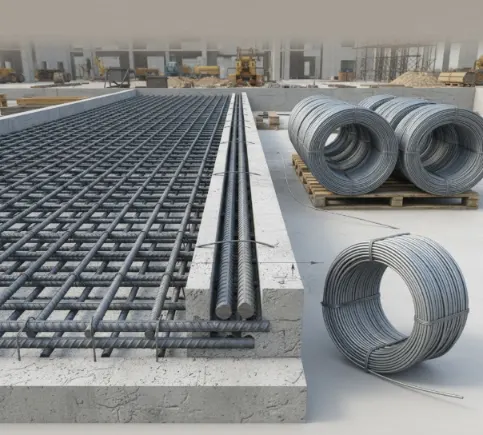
Specification Comparison for Concrete Reinforcement
Numbers still matter, especially when you compare grades and confirm compliance. Below is a practical spec snapshot you can use as a starting point. Actual requirements depend on your local code, bar size, and grade, so treat this as a screening tool, not a final design basis.
Quick Spec Snapshot
| Item | Typical Product Form | Yield Strength (Min) | Tensile Strength (Min) | Elongation (Typical/Min) | What It Means in Practice |
|---|---|---|---|---|---|
| High-Strength Wire Rod (Example: HRB500 Grade) | Coil | ≥ 500 MPa | ≥ 630 MPa | ≥ 12% | Higher yield can reduce steel quantity in some designs, but the final reinforcement form still matters |
| Traditional Rebar (Example: ASTM A615 Grade 60) | Straight bars (or coils) | ≥ 60 ksi (≈ 420 MPa) | tensile requirement varies by revision | Varies by bar size (minimums vary) | Most common baseline grade in many markets; strong default for structural concrete |
A quick note that trips up many buyers: ASTM A615 tensile strength requirements changed in the 2020 revision. Industry guidance notes tensile requirements for Grade 60 were reduced (commonly cited as 80,000 psi in that revision). If you source across regions, ask for the exact standard edition and mill test documentation. Otherwise, you may compare numbers that are not meant to match.
So Which Performs Better?
For primary reinforcement in structural concrete, traditional rebar usually performs better because bond and detailing are built into the product. That ribbed profile is doing real work after the pour.
Wire rod can still be part of a high-performing concrete reinforcement system, especially when it is processed into the right form (mesh, ties, or other engineered reinforcement) and when placement control is solid. HRB500-grade wire rod, for example, can bring high yield strength to projects that need it. But “wire rod” is not a magic substitute for rebar. The final reinforcement product and the bond behavior decide the result.
Sunrise New Material (Qingdao Sunrise New Material Co., Ltd.) at a Glance
If you source steel for concrete and infrastructure projects, you need two things that rarely show up in product photos: supply stability and paperwork that stands up to audit. Sunrise New Material positions itself as an international supplier of steel and non-ferrous metal raw materials, with a one-stop supply approach across multiple steel categories. The company states it holds ISO 9001:2015 certification and focuses on customized supply solutions, which matters when your project requires a specific grade, packing method, or documentation set for import and inspection. If your pain point is not “Can you sell steel?” but “Can you deliver the same spec, with the same traceability, again and again?”, that positioning is worth a closer look.
FAQ
Q1: Is wire rod the same thing as rebar?
A: Not really. Wire rod is a product form that usually comes in coils. Rebar is a reinforcement product made to bond with concrete, often with ribs on the surface.
Q2: Can wire rod replace traditional rebar in structural concrete?
A: In most structural elements, rebar is the safer default because bond and detailing are well proven. Wire rod can play a role when it becomes the right reinforcement form, like welded wire mesh, and when the design calls for it.
Q3: Why do ribs on rebar matter so much?
A: Ribs help the steel grip concrete. That reduces slip and improves load transfer after the concrete cures, which supports stiffness and crack control.
Q4: If HRB500 has higher yield strength, does that mean it is always better?
A: Higher yield strength helps in designs that benefit from it, but “better” depends on bond, detailing, and how you install reinforcement. Strength numbers alone do not tell you how the system behaves in real concrete.
Q5: What should you ask a supplier before you buy reinforcement steel?
A: Ask for the standard edition, the mill test certificate, heat number traceability, and a clear statement of mechanical properties. If you buy across regions, confirm you are comparing the same standard revision.