

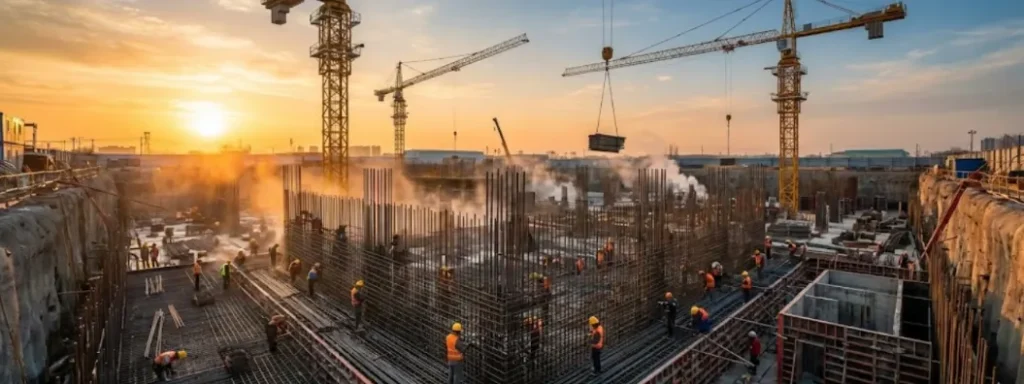
Building things in 2026 is expensive. Prices for raw materials keep climbing. Labor costs are not going down, either. For contractors and project managers, steel is often the biggest money pit on the spreadsheet. But there is a way to fix this. You just need to change the specs.
When you look at HRB400 vs HRB500, do not just stare at the price tag on a single bar. Look at the final bill for the whole job. Many builders stick with HRB400 because it seems cheaper upfront. That is a trap. By moving up to high-strength HRB500, you use less metal to do the same work. This guide shows how paying a tiny bit more for the grade lets you buy way less material. That cuts the total project cost down.
HRB400 vs HRB500: The Difference in Yield Strength
Forget the cash for a second. Let’s look at the metal itself. The codes stamped on the rebar tell you what it can take.
- HRB400: This is your standard bar with ribs. It handles a yield strength of 400 MPa. Think of it as the “regular unleaded” of steel, similar to ASTM A615 Grade 60.
- HRB500: This is the premium stuff. It has a yield strength of 500 MPa. It matches up with ASTM A615 Grade 75 or British Standard B500B.
The big difference between HRB400 and HRB500 rebar comes down to one thing: yield strength. HRB400 hits the limit at 400 MPa. HRB500 goes all the way to 500 MPa. Swapping to HRB500 lets the engineers shrink the steel size. This move theoretically cuts up to 19% in total steel tonnage for tall building foundations.
A close look at HRB400 vs HRB500 proves that the 500MPa grade lets you space the bars further apart. The math is simple. If the steel is 25% stronger, you don’t need as many bars to hold the building up.
Cost Analysis: How High-Strength Rebar Reduces Tonnage
Here is the part everyone cares about: the budget. Let’s imagine a 30-story office tower to see the real cash difference.
Suppose the first drawing calls for 10,000 tons of HRB400 rebar.
- HRB400 Price: Say the market rate is $550 a ton.
- Total Bill: $5,500,000.
Then, the structural engineer runs the numbers again using HRB500 high-strength rebar. Since the steel is tougher, the total weight drops. A safe bet is a 15% drop.
- New Tonnage: 8,500 tons.
- HRB500 Price: It costs a little more. Maybe $20 extra a ton. So, $570.
- Total Bill: 8,500 tons * $570 = $4,845,000.
The Bottom Line: You keep $655,000 in your pocket. Just on buying the metal.
But wait, there is more.
- Trucking: You have 1,500 fewer tons to ship. That is roughly 50 fewer trucks on the road.
- Work: Your crew has 15% fewer bars to cut, bend, and tie. The job gets done faster.
- Crane Use: Fewer lifts mean the crane is free for other stuff sooner.
Seismic Safety: Why Choose HRB500E for Earthquake Zones?
Building in California, Japan, or parts of China? Strength isn’t the only thing you need. You need stretch. That is where the “E” comes in (HRB500E).
Regular strong steel can be brittle. Like glass. If a big quake hits, brittle steel snaps. The building comes down. HRB500E is treated to be ductile. It has a high “Tensile-to-Yield” ratio (≥ 1.25). This means it stretches and bends without snapping. It soaks up the shock.
Picking the wrong grade causes failures. Avoid this mess by reading about common rebar mistakes that reduce seismic performance. Using HRB500E in key spots like column joints makes sure the building stays standing, even when the ground rolls.
Case Study: High-Rise Foundation Optimization
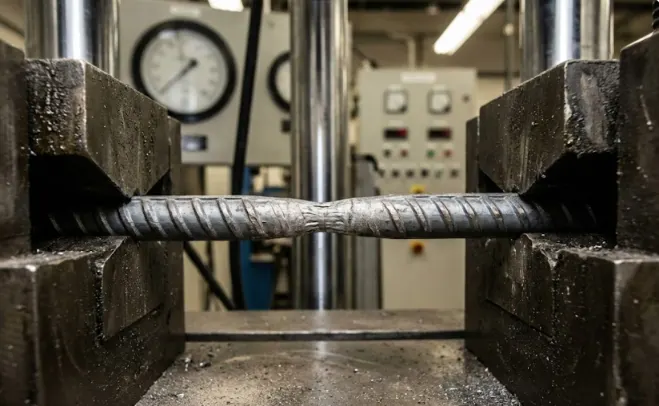
One huge headache on a job site is “rebar congestion.” In the base of a skyscraper, the design often needs so much steel it looks like a solid metal wall.
The Problem: When bars are packed too tight (using HRB400), the concrete can’t squeeze in. You get “honeycombing” or air holes. That makes for a weak foundation.
The Fix: Swap to thick HRB500 bars (like 40mm or 50mm). You need fewer of them. This opens up the gaps. The concrete flows in easy. The vibrator hits the bottom. The whole structure is solid.
For the stirrups that hold these big bars, you also need the right stuff. Knowing where high-strength wire rod is used helps design a better cage, so the whole skeleton works as a team.
Sourcing Strategy: Avoiding Quality Pitfalls
Not all 500MPa steel is the same. To get that strength, mills use different tricks.
Some mills use a cheap way called “Quench and Temper” (Q&T). They spray water on hot steel to freeze the skin. It makes the bar hard, but the middle stays soft. If you weld this, it gets weak.
The best makers add micro-alloys like Vanadium (V) or Niobium (Nb). This makes the steel strong all the way through. It costs a bit more to make. But it welds perfectly. It bends without cracking. When you ask for a quote, ask the supplier: “Is your HRB500 Vanadium-alloyed?” That one question saves you from buying brittle junk.
Global Steel Partner: Sunrise New Material
Finding the right metal is half the battle. Finding a seller who actually knows their stuff is the other half. Qingdao Sunrise New Material Co., Ltd. is a heavy hitter in the global steel game. They sit right in the sweet spot between high quality and fair pricing.
Sunrise New Material doesn’t just push metal out the door. They solve the headaches that come with big supply chains. They keep a massive stock of 300-series and 400-series stainless steel. They can slice up 430 coils for appliance makers. They have thick 304 plates for huge tanks. Based in China, they run strict ISO checks to make sure the chemistry matches the price tag. No surprises. Just solid steel.
If you are trying to deal with crazy 2026 prices, lean on Sunrise New Material. You get clear quotes and help getting the goods to your site on time. Whether you need coiled rebar for machines or huge straight bars for bridges, they have it ready. They even cut and bend it for you, which saves your crew time. Working with Sunrise isn’t just buying steel; it is locking in a supply chain that respects your deadline and your wallet.
In the end, the move from HRB400 vs HRB500 is a smart play to lower material volume and shipping bills.
FAQ
Q1: Can I just swap HRB400 for HRB500 and keep the drawing the same?
A: No! Don’t do that. If you use HRB500 but don’t lower the amount of steel, you are just burning money. Get a structural engineer to redo the math. Reduce the bar count. That is how you save.
Q2: Is HRB500 harder to bend?
A: A tiny bit, yeah. Since it is stronger, it wants to spring back more. Your guys might need to tweak the settings on the bender. But standard tools work fine.
Q3: What does the “E” stand for in HRB500E?
A: It stands for “Earthquake.” It means the steel is stretchy. If a quake hits, the steel gives a little instead of snapping. It keeps the building from falling flat.
Q4: Can I get HRB500 in any size?
A: Pretty much. You can find it from small 6mm coils up to giant 50mm bars. It is standard now. Finding it is easy.
Q5: Does HRB500 rust faster than HRB400?
A: Nope. They rust exactly the same. They are both carbon steel. If you are near the ocean, you need epoxy coating or galvanized bars, no matter how strong the steel is.